Sibyl Colefax & John Fowler: A legacy of British interior design
1930s
The story begins
The story of Sibyl Colefax & John Fowler begins in the 1930s.
Lady Colefax, a well-connected and creatively forward-thinking woman, begins her career in interior decoration. Her talent for creating spaces that are both comfortable and unpretentiously stylish quickly becomes sought after within her social circle.
The hall of Sibyl Colefax's house at Lord North Street
Her client list blooms, expanding to include a number of influential figures: several royals – including the Duke of Windsor and Wallis Simpson – much of the British aristocracy, and entertainers such as Charlie Chaplin and Cole Porter.
“Sibyl Colefax tells me that she (has) made £2,000 last year by her own efforts. She gets up by candlelight and fusses till midnight. A brave woman.”
By 1938 and already in her sixties, Sibyl’s services are in such high demand that she invites a rising talent, John Fowler, to leave his own studio on the King’s Road and join her in Bruton Street in Mayfair. Fowler, whose earlier tenures at Thornton Smith and the Peter Jones decoration studio honed his artisanal skills, is a brilliant colourist with a flair for hand-painted chinoiserie and a remarkable eye for detail.
With Lady Colefax’s influential connections and John Fowler’s artistic fortitude, the partnership prospers.
Just a year later, the firm adopts the name we know today: Sibyl Colefax & John Fowler.
Violet Trefusis with Sibyl Colefax, fashionable interior decorator and hostess, and Cecil Beaton courtesy of Martin Wood
The library of Sibyl Colefax's house at Lord North Street
1940s
A partnership emerges
As the end of the war nears, Britain presents a new landscape – one marked by austerity, rationing, and slow recovery. In this climate, John Fowler’s gift for conjuring characterful interiors on modest budgets proves invaluable. His ability to create beauty from constraint becomes a hallmark and he is credited as an early instigator of sustainable practices for his talent in reusing and repurposing materials.
In early 1944, Sibyl Colefax & John Fowler relocates to 39 Brook Street, the former residence of distinguished early 19th-century architect Sir Jeffry Wyatville. Over the next few years, and though post-war challenges persist – at one point, they lease the building’s ground floor to a Barclays branch to help cover expenses – the studio continues to flourish. A reputation grows steadily, especially for beautifully fashioned drapery, convivial seating arrangements, and that unmistakable air of comfort. The duo establish the sense of relaxed elegance that the Company is still known for today.
During this period, Fowler begins a long and influential association with TheNational Trust, undertaking the restoration and decoration of some of Britain’s most important historic houses. Among his most notable commissions: Clandon Park, Lyme Park, Sudbury Hall, Claydon House, and Uppark. His meticulous eye, immaculate taste and understanding of period detail earn him both national acclaim and the affectionate title “the prince of decorators,” bestowed by his friend, the Duchess of Devonshire – a sobriquet that sticks.
“Decoration is a logical compromise between comfort and appearance. A room must be essentially comfortable not only to the body but to the eye.”
The Hunting Lodge
In 1947, Fowler purchases The Hunting Lodge, an 18th-century folly which will become part of decorating history. He redecorates what goes on to be described as the prettiest small home in England to be “utterly unpretentious, very comfortable, with a veneer of elegance and informality and the feeling that one can sit down anywhere without having to move a chair.” A home where nothing feels out of place, and everything invites use. The Hunting Lodge remains his home until his death.
Nancy Lancaster
Around this time, a new chapter begins. Nancy Lancaster, an American heiress with a reputation amongst her friends as ‘having the finest taste of anyone in the world’, and a magpie’s eye for antiques, makes the startling but clever decision to buy what has become the country’s best known decorating firm from her friend Sibyl, who is now in her 70’s and with deteriorating health. Nancy brings a further impressive raft of social connections that allow the Company to soar into a grand new era.
Top floor at 292 King's Road showing John Fowler's rustic style
1950s
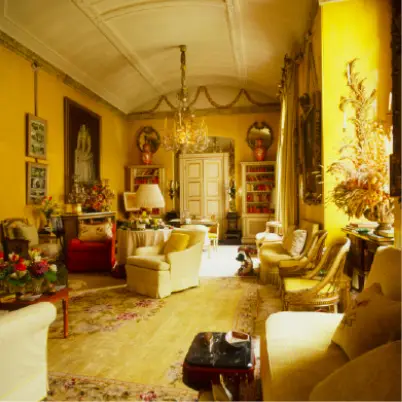
The Yellow Room at Brook Street
In 1957, Nancy Lancaster takes a 25-year lease on a set of rooms ‘over the shop’ at 39 Brook Street – a bed sit – as she deprecatingly calls it, whilst converting what had once been a ballroom. Encouraged by Fowler, she makes a radical and innovative decorating choice: to paint the drawing room in a brilliant glossy yellow. What is soon dubbed The Yellow Room steers decoration in a new and exciting direction over the following years, becoming perhaps the best-known and most influential interior in the history of English interior decoration.
“The warmth of that luminous colour, made up of layers and layers of lacquer, which made you feel you were inside the sun.”
As a result of its cultural and historical significance, 39 Brook Street, including the Yellow Room, is later granted Grade II* listed status.
Lancaster and Fowler’s working relationship, though long and legendary, is not without drama. Both strong-willed and mercurial, their creative partnership – often described as tempestuous – lasts over two decades. As Nancy Astor, Lancaster’s aunt, famously quipped:
“Frankly, they are the most unhappy unmarried couple I have ever met.”
Yet, for all the friction, their talents and tastes are complementary. In combination, they make a truly formidable decorating duo, changing the industry and setting presidents like no other. Their portfolio includes some of the country’s most distinguished homes: Chequers, the official country residence of the Prime Minister, and the AudienceRoom at Buckingham Palace, decorated for Her Majesty The Queen.
On Nancy Lancaster’s retirement, the yellow room becomes part of the showroom – a perfect, lived in, example of the Company’s legacy, and a testament to the timeless decorating acumen of Sibyl Colefax & John Fowler.
“I first saw the yellow room in the 70’s. Part of my job was to walk my then boss’s dalmatian to 39 Brook Street to collect a fabric sample. A friend was working there and she took me up to see the room. Of course I knew about it, but it was a revelation. So many wonderful things juxtaposed, looking uncontrived but put together with a very sophisticated eye for drama, glamour and comfort. And despite the serious degree of splendor, cosy.’’
Lady Colefax passes away at home on 22 September 1950, leaving behind a legacy of quiet sophistication and a thriving Company bearing her name.
With her impeccable taste and transatlantic charm, Nancy Lancaster builds upon this foundation. Her American connections enable her to forge a creative alliance with Sister Parish, the pioneering New York decorator. Together, these two doyennes of design influence the transatlantic aesthetic for decades to come.
In 1954, Lancaster acquires Haseley Court; a lovely, but faded, country house in Oxfordshire. Working carefully on its restoration and decoration together with John Fowler results in the beautiful drowsy elegance that is lauded as the epitome of the English Country House style: romantic, comfortably worn, and deeply personal.
1960s
A new direction
In 1960, Tom Parr acquires a significant shareholding in Sibyl Colefax & John Fowler Ltd and is appointed chairman. Parr, who had previously run a successful decorating business in Knightsbridge alongside David Hicks, is driven by challenge and ambition. With a razor-sharp business mind and a no-nonsense approach, he sees untapped potential in the Company and sets about modernising it from within.
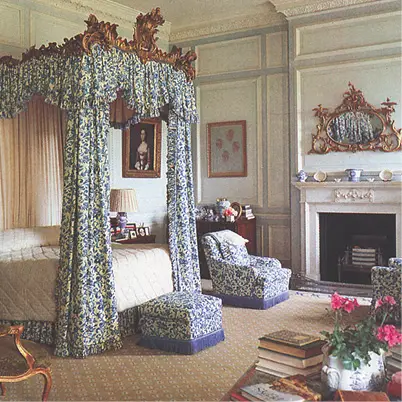
A fine, early Georgian room at Chicheley Hall decorated by Tom Parr
Sitting room, Sudeley Castle decorated by Stanley Falconer
He introduces a more rigorous commercial structure – establishing transparent client fees, expanding fabric ranges, and tightening operations. Under his leadership, the business becomes more ambidextrous, better positioned to serve a broader clientele while retaining its hallmark style. His own chic, somewhat masculine, design sensibility adds a fresh dimension to the firm’s visual language, appealing to a new generation and setting the stage for the sense of versatility represented by the decorators today.
As John Fowler increasingly devotes himself to his advisory role with The National Trust, he gradually steps back from private commissions and is content to pass the reins, entrusting the Company’s direction to Parr. Under Tom’s guidance, the number of in-house decorating teams expands, bringing new energy and capability to the Company. Despite a famously short fuse, Parr proves a generous mentor and plays a crucial role in cultivating the next generation of talent. Imogen Taylor, after 17 years as Fowler’s trusted assistant, is promoted to lead her own team. She soon becomes one of the most prominent decorators of her era, her projects extending well beyond Britain to the Middle East and the United States, helping to further solidify the Company’s international reputation.
She is joined in this new era by Stanley Falconer, Chester Jones, and David Laws – each bringing their own distinctive style and sensibility, and each contributing to the Company’s growing status as a house of diverse creative voices, united by a shared commitment to timeless design.
London sitting room decorated by Tom Parr
Evangeline Bruce's drawing room decorated by John Fowler
1970s
Synonymous with chintz
In 1971, John Fowler officially retires – a momentous transition for the Company he helped shape. Though he steps away from private commissions, he remains quietly present: retaining modest lodgings on the second floor of Brook Street, along with a small office on the first floor, where he continues his advisory work for The National Trust. The remainder of his time is spent at his beloved Hunting Lodge.
Bowood
Fuchsia
His departure signals a new chapter, marked by what would become one of the Company’s most significant departures from its original blueprint: the retailing of fabrics and wallpapers.
In 1973, The Chintz Shop opens on Ebury Street, launching its first ready-made fabric collections. These early collections are revolutionary, giving Sibyl Colefax & John Fowler greater visibility to a wider public. Until then, the designs had largely been the preserve of a private, often aristocratic, clientele. With the advent of retail, that signature aesthetic could now be enjoyed in homes across the country. These early lines are transformative, establishing a new identity as both a decorating firm and a celebrated fabric house. As Tom Parr boldly states, he wants the Company to be “synonymous with chintz.”
In 1976, Wendy Nicholls – present day Chairman of Sibyl Colefax & John Fowler’s decorating division – joins the decorating team, along with Vivien Greenock and Roger Banks-Pye, each of whom will go on to make significant contributions to its creative legacy.
Key to the success of the fabric and wallpaper collections is George Oakes, the talented artist who had worked closely with Fowler on numerous private commissions. Oakes takes charge of designing the Company’s textile ranges, drawing inspiration from mid-to-late 19th-century documents, with occasional nods to Regency and 18th-century motifs. His chintzes are immediately distinctive, rich with historical reference yet strikingly fresh. Among the first and most iconic are Bowood and Fuchsia, patterns that remain in production to this day – quintessential expressions of enduring English style.
George Oakes's mural decoration at Sezincote, Gloucestershire
The Brook Collection launched 1982
1980s - 1990s
Creative Expansion
The 1980s and 1990s mark a period of confident expansion and creative reinvention for Sibyl Colefax & John Fowler, as it builds upon its distinguished heritage while embracing the diverse tastes of the era. Under Tom Parr’scontinued leadership, it deftly balances tradition with innovation, appealing to clients who value timelessness but seek a more contemporary expression of the English look.
“Colefax changes very slowly over the years - almost imperceptibly.”
In 1983, Nancy Lancaster relinquishes the rooms above the Brook Street showroom as she moves towards retirement – an opportune moment, as the ever expanding Company requires the space. During this time, the decorating division becomes a crucible for some of the most distinctive talents in British interior design.
Roger Banks-Pye emerges as one of the Company’s most flamboyant and imaginative figures. His rooms – layered, witty, and often theatrical – prove that the English country house style need not be staid; it can be dramatic, irreverent, and surprising. Wendy Nicholls and Vivien Greenock bring a quieter elegance to their work; upholding a reputation for comfort, craftsmanship, and subtle sophistication. Together they create interiors that reflect a deep understanding of scale, proportion, and lived-in charm, resonating with clients both in Britain and internationally. This period also sees Chester Jones rise to prominence with an architectural aesthetic and modern eye that integrates contemporary elements within traditional settings with remarkable fluency. Emma Burns, present day joint Managing Director of Sibyl Colefax & John Fowler, joins the Company working for the fabric arm – it is the beginning of a remarkable career, marked by a resolute commitment to thoughtful design.
“I knew in a split second that I would rather make the tea in those hallowed surroundings than work anywhere else in the world.”
Throughout these decades, the Company maintains a thoughtful equilibrium: reverence for the past paired with a nuanced application of the present. The decorators remain united by a belief in interiors that evolve over time, that combine inherited pieces with contemporary, and that reflect the lives of their inhabitants.
Prints & Chintzes
The fabric and wallpaper division also thrives. New collections build on the established visual language of the 1970s; its signature prints and chintzes – including the first collection to include wallpapers,The Brook Collection – are infused with a classic humble English beauty but also with a sort of aspirational, effortless chic that is embraced from London to New York to the Middle East.
In 1986, a new showroom opens on Fulham Road; the original Chintz Shop proving too small for the flourishing business. With a daring vision and a keen reading of the times, Fulham Road becomes the prêt-à-porter side of the Company; a more accessible point of entry aimed at a younger market, without diluting the core identity of Brook Street.
That same year, David Green is appointed Chief Executive of Colefax and Fowler, and in 1996, upon Tom Parr’s retirement, he becomes Chairman. His arrival signifies a new phase of expansion, extending a global reach and incorporating several prestigious brands under the Colefax Group umbrella.
In the 1990s, the interior decorating and antiques division returns to its original name, Sibyl Colefax & John Fowler– a reaffirmation of its identity as the Company’s haute couture arm with a focus on bespoke interiors and craft-driven product, preserving the intimate, detail-oriented spirit of its founders.
Janey Money joins in 1998, a year before Nancy Lancaster formally retires in 1999, concluding an extraordinary fifty-years with the Company. By the end of the century, Sibyl Colefax & John Fowler has not only survived the shifting landscape of half a century, but flourished – remaining one of the most admired and enduring names in British interior decoration.
2000s - PRESENT
Enduring Character
As Sibyl Colefax & John Fowler enters the 21st century, it does so with a rare sense of continuity – anchored by its illustrious past but never confined by it. The firm remains at the forefront of British interior decoration, defined not by a single aesthetic, but by a shared ethos: timelessness, comfort, and individuality.
In 2001, with a strong foundation in architecture and a substantial tenure working alongside John Stefanidis before establishing his own practice, Philip Hooper joins the decorating team. His architectural grounding and passion for detail become the cornerstone of his approach, and as the years progress, will lead him to become joint Managing Director alongside Emma Burns. His arrival signals the next stage of evolution, followed by the addition of Lucy Hammond Giles in 2004, and Mathew Claridge in 2012 who establishes the architectural and interior studio, which offers a complete project experience, blending detail and practicality.
“Moving to 89-91 Pimlico Road from our iconic Mayfair Showroom heralded the start of a new era. But Brook street is never too far from our minds. Lucy Hammond Giles’s WOW house paid homage to Nancy’s tour de force, while I decided to do a yellow room at home out of devilment, just to see if I could pull it off”
Pimlico Road
In 2017, Sibyl Colefax & John Fowler relocates its London showroom and studio from its historic Mayfair address at Brook Street to a late Victorian red-brick terrace in the heart of Pimlico Road, London’s renowned design and antiques district, where it continues to flourish. The ground floor houses the collection, and serves as a physical expression of a remarkable collective expertise; hosting a carefully curated selection of products and antiques with a strong emphasis on craftsmanship.
Today, the decorating division remains under the guidance of Wendy Nicholls, her stewardship upholds the Company’s founding values while allowing space for evolution and fresh perspectives. She is joined by a talented team of decorators, each of whom brings a distinct voice and design sensibility, collectively contributing to the rich and varied tapestry of Sibyl Colefax & John Fowler’s enduring character.